

Who?
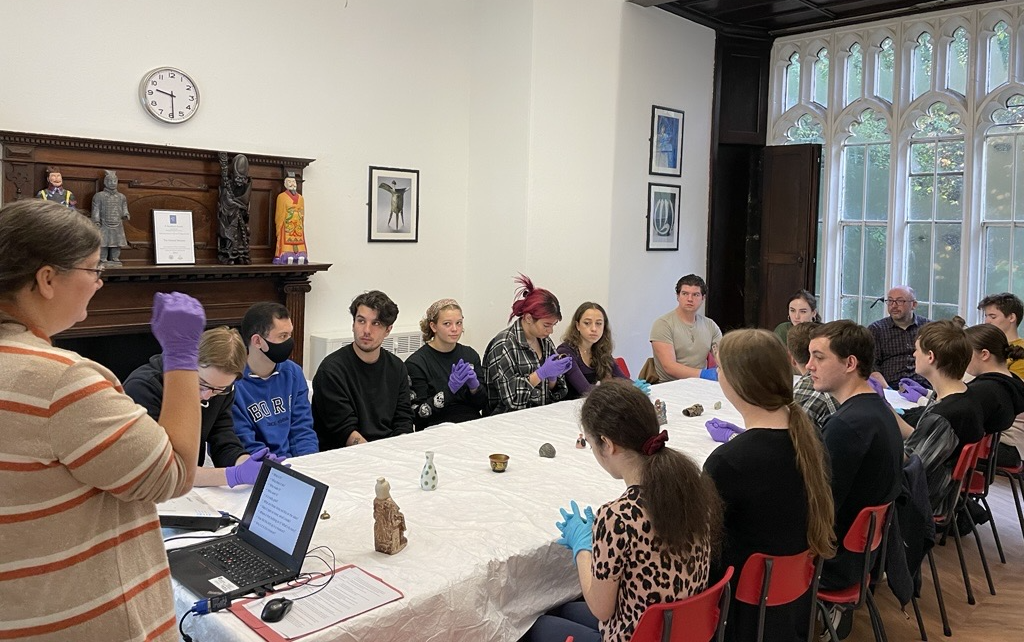
Dr Alison McManus and foundation students taking the redesigned Research in Action modules, including Texts & Contexts and Museums & Material Culture. The redesign emerged from concerns about student engagement, authenticity in assessment, and the implications of generative AI for teaching and learning.
What?
This project involved redesigning assessment around active learning principles to promote deeper engagement, greater student ownership, and more authentic demonstrations of learning in an AI-enabled environment. Rather than attempting to prevent AI use, the redesign aimed to make students’ thinking processes visible through inquiry-based, personalised, and reflective assessment tasks.
The approach was guided by concerns that traditional assessments can encourage surface-level learning and are increasingly vulnerable to AI-generated responses. At the same time, AI presented an opportunity to rethink what is valued and assessed in higher education.
When?
The redesign was piloted during 2025/26 within the Foundation Programme’s Texts & Contexts module, with further implementation planned in Culture, Power & Identity for 2026/27.
How?
The redesign was underpinned by five key principles: authentic inquiry, process over product, visible thinking, social learning, and critical, evidence-based analysis.
Texts & Contexts
Students…
- …selected a pair of literary texts from a curated set of options including Jane Eyre and Wide Sargasso Sea, 1984 and Julia, or Huckleberry Finn and James.
- …generated or were provided with an AI-produced comparative essay examining the chosen texts within literary, historical, or theoretical contexts.
- …participated in an assessed tutorial where they presented annotated extracts and an annotated bibliography to support their analysis.
- …submitted a final portfolio consisting of:
- A 1,000-word critical commentary evaluating the extent to which selected textual evidence supported or challenged the AI-generated argument.
- A 500-600 word reflective commentary incorporating discussion-based learning and self-evaluation.
Culture, Power & Identity
Students engage with local collections and institutions through two authentic assessment tasks:
- Analysing an object from Palace Green Library or Durham’s Oriental Museum, considering practical, legal, and ethical questions surrounding display and curation.
- Contextualising that object with five others and thereby developing a public-facing mini-exhibition organised around a student-selected theme.
The assessments draw on University resources and provide opportunities for students to undertake meaningful, situated inquiry rather than producing conventional essays.
Why?
Several challenges prompted the redesign:
- Increasing concerns about student engagement and ownership of learning.
- Difficulties establishing authorship and authenticity in traditional written assessments in an era of generative AI.
- Recognition that traditional essay formats can sometimes reward outputs rather than intellectual processes.
- A desire to create assessments that are personalised, authentic, and rooted in meaningful disciplinary inquiry.
Rather than focusing on detecting AI use, the redesign sought to assess reasoning, judgement, interpretation, and reflection, encouraging students to demonstrate how they arrived at their conclusions.
How did it go?
Although evaluation is ongoing, initial outcomes have been encouraging.
Moderation of the pilot Texts & Contexts assessment identified high levels of student engagement and an overall improvement in the quality of submitted work. Students demonstrated sophisticated critical engagement with AI-generated arguments, frequently identifying limitations, generic interpretations, and factual inaccuracies. Rather than accepting AI outputs uncritically, students used evidence from primary and secondary sources to challenge, refine, or qualify those arguments.
Personalisation appeared to increase investment in learning, while assessed tutorials provided opportunities for richer academic conversations and deeper student reflection. These tutorial discussions were among the most rewarding aspects of the redesigned approach.
Student responses were varied. Many appreciated the opportunity to engage in a more active and authentic process, although a few expressed a preference for traditional comparative essays. The assessment design also created opportunities for differentiation, allowing students to engage at different levels of complexity while maintaining a common framework.
What challenges emerged?
Several questions remain under consideration:
- Student perceptions of non-traditional forms of assessment can vary considerably.
- Scaling tutorial-based and process-focused assessment for larger cohorts may have resource implications.
- Questions surrounding the ethical use of AI, including its broader societal and environmental implications, remain important areas for discussion.
What’s next?
The redesigned modules will continue to be evaluated as they are rolled out across the Foundation Programme. Particular attention will be paid to student engagement, assessment outcomes, scalability, and students’ developing relationships with AI as a learning tool.
The broader aim is to continue moving from assessments that focus primarily on answers towards assessments that foreground process, judgement, reflection, and authentic disciplinary practice. In this model, AI is not treated solely as a threat to academic integrity but as a tool whose strengths and limitations can become part of the learning process itself.